
Cab Rental Hub

πŸš— Delhi NCR's Most Trusted Monthly Cab Serviceβ—† Corporate Contracts Availableβ—† Fixed Monthly Rates β€” No Surge Pricingβ—† 24/7 Dedicated Supportβ—† 500+ Happy Families & Corporatesβ—† πŸš— Delhi NCR's Most Trusted Monthly Cab Serviceβ—† Corporate Contracts Availableβ—† Fixed Monthly Rates β€” No Surge Pricingβ—† 24/7 Dedicated Supportβ—† 500+ Happy Families & Corporatesβ—†
Cost of Employee Cab Services vs Reimbursing Fuel Bills

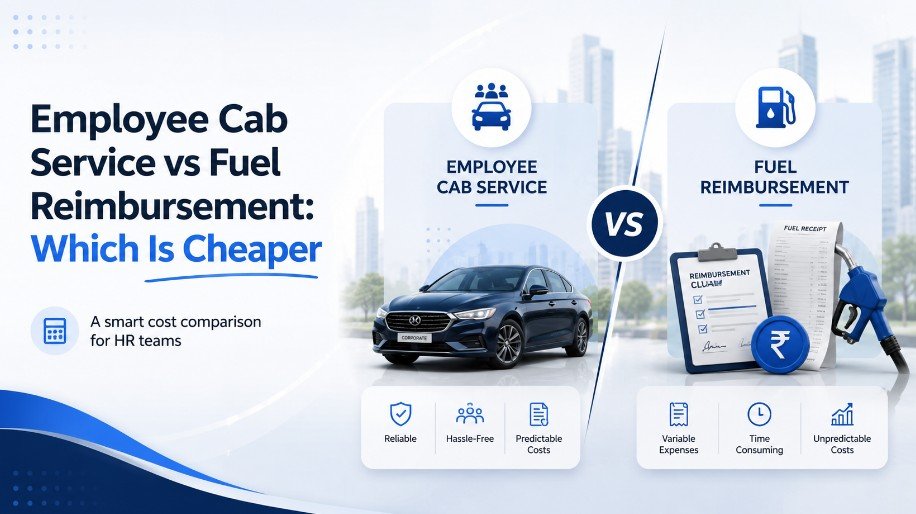
Employee Cab Service vs Fuel Reimbursement: Which Is Cheaper

Cost of Employee Cab Services vs Reimbursing Fuel Bills

Cost of Employee Cab Services vs Reimbursing Fuel Bills — Which Is Cheaper?

Summary

For most companies moving a group of employees on fixed routes, a shared employee cab service is cheaper per head than reimbursing individual fuel bills, because one vehicle carrying four to six people replaces four to six separately fuelled cars. Fuel reimbursement tends to win only when employees are few, spread across unrelated routes, or travelling on irregular days where a pooled cab would run half-empty. The honest answer depends on three numbers: how many employees share a route, how far they travel, and how predictable their schedule is. The comparison also has to count the hidden costs on both sides – administration and leakage on the reimbursement side, idle-vehicle cost on the cab side. This guide gives a simple framework to run the maths for your own team, and cabrentalhub.in is one place to benchmark real monthly cab rates while you do.

Key Takeaways

  • Shared cabs beat fuel reimbursement on cost when three or more employees share a route, because the per-seat cost falls as occupancy rises while reimbursement cost stays flat per person.
  • Fuel reimbursement is cheaper for scattered, low-density teams, where any cab would travel largely empty and pooling is impossible.
  • The true cost of reimbursement is higher than the fuel figure, once you add processing time, verification, fraud leakage and the absence of any safety or reliability control.
  • The true cost of a cab service is the effective per-seat cost, not the vehicle rate, so occupancy is the single most important variable in the comparison.
  • Reimbursement offers no night-shift safety, no reliability guarantee and no attrition benefit, which are real but non-fuel costs that a cab contract absorbs.
  • The break-even point in most Indian metros sits around three shared employees per vehicle on a fixed daily route of 15 to 30 km each way.

What is the real question: cab service or fuel reimbursement?

The real question is not “which has a lower sticker price” but “which delivers a reliable, safe commute at the lowest total cost per employee.” Employee cab service means the company arranges shared or dedicated vehicles for the commute and pays the operator. Fuel reimbursement means employees drive their own vehicles and the company repays their fuel expense, usually against bills or a per-kilometre rate.
These two models are not interchangeable substitutes. They differ in who bears the driving, who bears the risk, and how cost scales with headcount. A fuel-reimbursement rupee buys only fuel; a cab-service rupee buys fuel plus the vehicle, driver, maintenance, insurance, GPS and a service guarantee. Comparing the two fairly means counting everything on both sides, which the rest of this guide does. For the wider set of commute models beyond these two, see this guide to employee transportation solutions.
Want to know what a shared cab actually costs for your team?
Send us your route and headcount – we’ll share a real per-employee monthly figure to compare against fuel bills.

How do you actually calculate the cost of each option?

You calculate the cost of each option by reducing both to a comparable unit: total monthly cost per employee. The formulas below make the two directly comparable.

Fuel reimbursement, per employee per month:
(round-trip distance in km) × (working days) × (₹ reimbursed per km) + processing cost per claim

Shared cab service, per employee per month:
(monthly vehicle cost) ÷ (employees sharing that vehicle)

The second formula is why occupancy dominates the comparison. A vehicle costing ₹30,000 a month is ₹30,000 per head with one passenger, ₹10,000 with three, and ₹5,000 with six. The vehicle rate never changes; the per-employee cost collapses as the seats fill.

A worked example

Consider six employees on the same 40 km round-trip route, 22 working days a month.
Cost lineFuel reimbursementShared cab (one 6-seater)
Distance basis40 km × 22 days = 880 km eachShared vehicle, all six
Fuel/rate cost880 km × ₹8/km = ₹7,040 per employeeVehicle at ~₹36,000/month
Per-employee vehicle cost₹36,000 ÷ 6 = ₹6,000
Processing / admin~₹200 per employeeIncluded in one invoice
Safety & trackingNoneIncluded
Total per employee / month~₹7,240~₹6,000
Total for six / month~₹43,440~₹36,000
In this fixed-route, high-occupancy case the shared cab is roughly 17% cheaper and adds safety, tracking and reliability that reimbursement does not. The figures are illustrative – plug in your own distance, rate and vehicle cost, since fuel prices and cab rates vary by city and change over time.

When the maths flips

Now change one variable: the six employees live in six different directions and travel on unpredictable days. Pooling is impossible, so you would need up to six vehicles or six dedicated cabs, and per-employee cab cost jumps toward the full vehicle rate. Here fuel reimbursement – which stays at ~₹7,240 per person regardless of how scattered they are – becomes the cheaper option. Occupancy, not distance, is what moves the answer.

Employee cab service vs fuel reimbursement: full cost comparison

The table below compares the two models across every cost and non-cost factor that matters, not just fuel.
FactorEmployee cab serviceFuel reimbursement
Cost driverPer-seat cost (falls with occupancy)Per-employee fuel (flat)
Cheapest when3+ employees share a routeFew, scattered employees
Admin effortOne monthly invoiceOne claim per employee per cycle
Leakage / fraud riskLow (metered by trip)Higher (inflated or padded bills)
Night-shift safetyBuilt in (GPS, verified drivers, escort)None
Reliability guaranteeSLA-backedNone – employee’s own vehicle
Employee out-of-pocketNilPays upfront, waits for reimbursement
Attrition impactReduces commute-related exitsNeutral to negative
Vehicle wear costBorne by operatorBorne by employee
Scales with headcountImproves (better pooling)Stays flat per head

What hidden costs does fuel reimbursement carry?

Fuel reimbursement carries four hidden costs that never appear on the fuel bill: administrative processing, verification effort, fraud leakage, and the absence of any safety or reliability guarantee.
Administrative processing is the finance team’s time spent collecting, checking and paying claims every cycle. Verification is the effort of confirming that bills are genuine and distances are real, which most companies do only loosely. Fraud leakage is the gap between claimed and actual fuel use – padded odometer readings and personal-use fuel charged as commute are common and hard to police. And because the employee drives their own car, the company gets no night-shift safety cover, no GPS trail, and no recourse if the employee’s vehicle breaks down. These are real costs even though none of them is a fuel cost.
Tired of chasing and verifying fuel claims every month?
A single monthly cab invoice replaces dozens of individual claims – metered, transparent and GST-compliant.

What hidden costs does an employee cab service carry?

An employee cab service carries its own hidden cost: idle-vehicle cost when occupancy is low. A committed vehicle that runs half-empty is being paid for at close to its full rate while serving only two or three of its seats, which pushes the per-seat cost up toward the reimbursement figure.

Two smaller costs also apply. Dead kilometres – the distance a vehicle travels to reach the first pickup – inflate the bill if the contract is billed garage-to-garage rather than office-to-office. And a poorly written contract can hide charges for extra kilometres, night allowance and detention. Both are controllable: the way to control them is a clear corporate cab contract with the billing basis and extra-charge heads fixed in writing. Get occupancy and contract terms right, and the cab model keeps its cost advantage.

Which option should a company choose? A simple framework

Choose between the two models using three questions, answered in order.
  1. Can employees be pooled? If three or more employees share a route and a broadly common schedule, a shared cab is almost always cheaper per head and adds safety. If employees are few and scattered on unrelated routes, reimbursement is usually cheaper.
  2. Is there a night shift or a women’s-safety obligation? If yes, cab service is effectively mandatory in most Indian states regardless of cost, because reimbursement provides no safe-transport cover. Formalise the rules in an employee transport policy template.
  3. Is the schedule predictable? Predictable, fixed-route demand favours a monthly cab contract. Highly irregular, seasonal or ad-hoc travel favours reimbursement or pay-per-trip cabs, because a committed vehicle would sit idle.
Many companies land on a hybrid: a monthly cab contract for the dense, fixed-route core, and fuel reimbursement for the scattered tail of employees who can’t be pooled. This is usually the lowest-total-cost answer for a mid-sized team.

Does the choice affect retention, not just cost?

Yes – the choice affects retention as well as cost, and the retention effect often outweighs the fuel difference. A reliable, safe commute reduces the daily friction that drives resignations, particularly for night-shift and long-distance employees. A model that saves a few hundred rupees per head but leaves employees managing an unreliable, unsafe or reimbursement-delayed commute can cost far more in commute related attrition than it saves in fuel.

Not sure whether cabs or reimbursement fits your team?
Tell us your routes and headcount – we’ll suggest a cab-only or hybrid plan with a clear per-employee cost.

Does city and route change the answer?

Yes – city density and route distance change the answer significantly, because both affect achievable occupancy and per-km cost. Dense metros with employees clustered along corridors make pooling easy, which favours cab service. Sprawling or low-density locations make pooling hard, which pushes some employees toward reimbursement.
Route pairs matter too. A high-volume corridor like a Monthly cab service from noida to faridabad run supports full vehicles and a low per-seat cost, while a thin, one-off route may not fill a cab at all. The same logic distinguishes a well-used monthy cab service in delhi route from a sparse suburban one, or a clustered daily cab service in faridabad pool from scattered individual commutes. Run the occupancy maths per route rather than assuming one model fits the whole company.

Conclusion

For a company moving employees along shared, predictable routes, an employee cab service is usually the cheaper option once you count occupancy and the hidden costs of reimbursement – and it adds safety and reliability that fuel reimbursement cannot. Fuel reimbursement holds its place for small, scattered, irregular groups where no cab could run full. The decision comes down to three numbers – employees per route, distance, and schedule predictability – and most mid-sized teams end up with a hybrid rather than a single model. Run the per-employee-per-month calculation for each route before deciding, and treat safety obligations as a separate, non-negotiable input. Companies benchmarking real rates for the cab side, including monthly private cab service and shared options, can compare current packages on cabrentalhub.in while running the numbers.
Ready to run the numbers with real rates?
Share your route and headcount – we’ll send a monthly cab quote you can compare against your fuel bills.

Frequently Asked Questions (FAQs)

Is an employee cab service cheaper than fuel reimbursement?

An employee cab service is usually cheaper than fuel reimbursement when three or more employees share a route, because the per-seat cost falls as the vehicle fills while reimbursement stays flat per person. For small, scattered teams travelling on unrelated routes, fuel reimbursement is often cheaper because a pooled cab would run largely empty. The deciding factor is occupancy, not distance.

How do you calculate the cost of employee cab service per person?

You calculate the per-person cost of a shared cab by dividing the total monthly vehicle cost by the number of employees sharing that vehicle. A vehicle costing ₹36,000 a month shared by six employees costs ₹6,000 per head, but the same vehicle used by two costs ₹18,000 per head. This is why keeping occupancy high is the single most effective way to lower cab cost.

What are the hidden costs of fuel reimbursement?

The hidden costs of fuel reimbursement are administrative processing time, bill verification effort, fraud leakage from padded or personal-use claims, and the complete absence of night-shift safety and reliability cover. None of these appears on the fuel bill, but together they raise the true cost well above the reimbursed amount. They also expose the company on safety, which reimbursement does not address at all.

When is fuel reimbursement the better choice?

Fuel reimbursement is the better choice when employees are few, live in different directions, and travel on irregular days, because pooling is impossible and any cab would travel mostly empty. It also suits senior staff who prefer their own vehicle. It is not appropriate where a night shift or women’s-safety obligation requires company-provided safe transport.

Can a company use both cab service and fuel reimbursement?

Yes, many companies use a hybrid model: a monthly cab contract for the dense, fixed-route core of employees who can be pooled, and fuel reimbursement for the scattered tail who cannot. This usually produces the lowest total cost for a mid-sized team. The split is decided route by route based on how many employees can share each vehicle.

Does providing cabs instead of reimbursement reduce attrition?

Providing a reliable, safe cab service can reduce commute-related attrition, especially among night-shift and long-distance employees for whom an unreliable commute is a common reason to resign. The retention saving often exceeds the fuel-cost difference between the two models. Reimbursement, by contrast, leaves the commute experience entirely to the employee.

Which is safer for night-shift employees — cabs or reimbursement?

A cab service is far safer for night-shift employees, because it provides GPS-tracked vehicles, police-verified drivers, and escort arrangements that most Indian states require for women on night shifts. Fuel reimbursement provides none of this, as the employee drives alone in their own vehicle. For night-shift transport, cab service is effectively mandatory rather than optional.

Get In Touch With Us

Leave a Comment

Your email address will not be published. Required fields are marked *

WhatsApp Chat on Whatsapp