
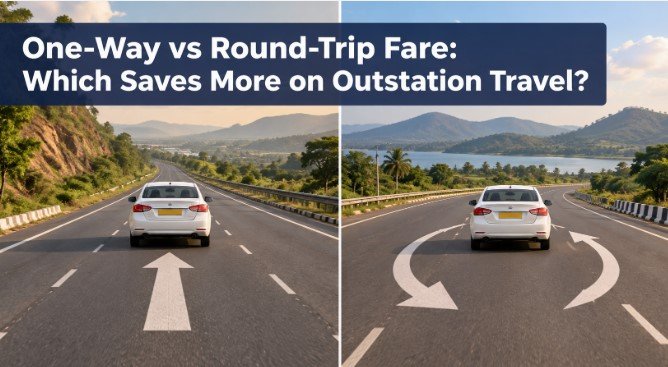
One-Way vs Round-Trip Fare: Which Saves More on Outstation Travel?
Summary
On outstation travel, a round-trip fare is almost always cheaper per kilometre than a one-way fare, because a one-way drop has to cover the driver’s empty return journey while a round trip uses the vehicle in both directions. The real question is not which rate is lower, but which total cost fits your trip: if you are coming back within a day or two, a round trip usually saves more; if you genuinely do not need the return leg – a relocation, a one-way airport drop, or onward travel by train or flight – a one-way fare avoids paying for a return you will not use. The catch is that one-way fares vary a lot by route and direction, because they depend on whether the operator can find a return passenger, so the saving is situational. The way to decide is simple: work out the total, all-inclusive cost of each option for your actual plan, not the headline per-km rate. This guide explains how one-way and round-trip fares are calculated, shows a worked example, and helps you pick the cheaper option for your trip.
Key Takeaways
- Round-trip is cheaper per km, because a one-way fare must cover the driver’s empty return.
- One-way wins only when you truly skip the return – a relocation, an airport drop, or onward by train/flight.
- Round trips bill a daily minimum (often 250–300 km/day), which shapes the cost on short-distance, multi-day trips.
- One-way fares swing by route and direction, depending on return-passenger availability.
- Compare total, all-inclusive cost, not the per-km rate – tolls, allowance and taxes change the answer.
- If you return within a day or two, a round trip almost always saves more.
How are one-way and round-trip fares calculated?
The two fare types are built differently, and understanding that is the whole key to choosing well. A round-trip fare charges for the full to-and-fro distance (or a daily package), and because the same vehicle serves both legs, the per-kilometre rate is lower. A one-way fare charges only for your single leg, but it builds in the cost of the driver bringing the empty vehicle back, so the effective per-kilometre rate is higher.
That single difference – who pays for the return journey – explains almost everything about which is cheaper. It also explains why one-way rates are unpredictable: if the operator can line up a return passenger for the empty leg, the one-way fare can drop; if not, it stays high. Round-trip pricing has no such uncertainty, which is part of why it is the more common outstation choice.
| Fare type | What you pay for | Per-km rate | Best when |
|---|---|---|---|
| Round-trip | Both legs (or a daily package) | Lower | You return within a day or two |
| One-way | Your single leg + driver’s empty return | Higher | You do not need the return at all |
When does a round-trip fare save more?
A round-trip fare saves more whenever you are returning to your start point within a reasonable time – a day trip, a weekend away, or a two-to-three-day tour. Because the per-kilometre rate is lower and the same driver and vehicle stay with you throughout, the round trip is usually both cheaper and more convenient for these journeys.
It also lets you keep the cab for local sightseeing at the destination within the kilometre limit, so a temple visit, a market run or a side trip is included rather than a fresh booking. For most leisure and family outstation travel – where you go, spend time, and come back – the round trip is the natural, more economical choice. On a popular route like a Faridabad to Jaipur cab, a round trip covering the drive there, local sightseeing and the return is typically the best value for a weekend.
Planning a return outstation trip?
Tell us your route and dates – we’ll share an all-inclusive round-trip fare that covers both legs and local running, with no per-km guesswork.
When does a one-way fare make sense?
A one-way fare makes sense only when you genuinely do not need the return leg, so paying for a round trip would mean paying for a journey you will not take. The clearest cases are a relocation or shifting to another city, a one-way airport drop where you fly onward, or a trip where you continue from the destination by train, flight or another vehicle.
In these situations, a one-way fare – despite its higher per-kilometre rate – is cheaper than a round trip because you are not funding an unused return. One-way rates are also better on busy corridors where the operator can more easily find a return passenger for the empty leg, so it is always worth asking for a specific one-way quote for your route and direction rather than assuming it is unaffordable.
A worked example: how the maths plays out
To see the logic clearly, here is an illustrative comparison using placeholder rates – your actual figures will differ, so treat this only as a way to understand the maths, not as a quote. Imagine a city-to-city trip of a set distance one way.
| Scenario | How it is charged | Which is cheaper |
|---|---|---|
| Same-day return trip | Round trip on to-and-fro distance at a lower per-km rate | Round trip |
| Weekend (2–3 days) | Round trip with a daily minimum; you keep the cab | Round trip (plus sightseeing) |
| One-way drop, no return needed | One-way leg + driver’s empty return, higher per-km | One-way |
| Onward by train/flight | One-way, since a return would be wasted | One-way |
The pattern is consistent: when the return is used, the round trip’s lower rate wins; when the return would be wasted, the one-way avoids paying for it. The only reliable way to confirm which is cheaper for you is to get an all-inclusive quote for both and compare the totals, not the rates.
What else affects the total cost?
Beyond the base fare, a few factors shape the final bill for either option, and they can tip the balance – which is exactly why comparing per-km rates alone is misleading.
- Daily minimum kilometres: round trips often bill at least 250–300 km per day, which matters on short-distance, multi-day trips.
- Driver allowance: a per-night charge on multi-day trips, applying to round trips that stay overnight.
- Tolls, parking and state taxes: added at actuals on both options unless bundled in.
- Route and direction: one-way rates swing with return-passenger availability.
- Night charges: may apply for late-night driving on either fare type.
Because these extras apply differently to each option, an all-inclusive total is the only fair comparison. A reputable Cab Rental Hub Faridabad will give you a clear, itemised quote for both one-way and round trip so you can see the real difference for your route.
Not sure which fare is cheaper for your trip?
Share your route, dates and whether you need the return – we’ll quote both one-way and round-trip, all-inclusive, so you can compare totals.
How to decide: one-way or round-trip?
Answer these questions and the cheaper option is usually clear.
- Do you need to come back? If yes, lean round trip; if genuinely no, consider one-way.
- How soon do you return? Within a day or two strongly favours a round trip.
- Do you want local sightseeing at the destination? A round trip includes it within the km limit.
- Is it a relocation or onward journey? That is the classic case for one-way.
- Have you compared all-inclusive totals? Always decide on totals, never on per-km rates.
As a rule of thumb: return within two to three days, choose a round trip; not returning at all, choose one-way; and whenever it is close, ask for both quotes and compare the final payable amounts.
Get the cheaper fare for your outstation trip
Send your route, dates and whether you need the return – we’ll quote both one-way and round-trip all-inclusive, so you pick the one that saves more.
Conclusion
For most outstation travel, a round-trip fare saves more, because its lower per-kilometre rate and shared use of the vehicle beat a one-way fare that has to cover the driver’s empty return – and it throws in local sightseeing within the limit. A one-way fare only wins when you truly do not need the return, such as a relocation, an airport drop or onward travel by train or flight. Since one-way rates swing with route and direction, and extras like the daily minimum, driver allowance and tolls shift the total, the golden rule is to compare all-inclusive totals rather than headline rates. Get a clear quote for both, match it to whether you are actually returning, and you will always land on the option that genuinely saves more.
Frequently Asked Questions (FAQs)
Is a one-way or round-trip cab fare cheaper for outstation travel?
A round-trip fare is almost always cheaper per kilometre, because a one-way fare must cover the cost of the driver bringing the empty vehicle back, while a round trip uses the vehicle in both directions. So if you are returning within a day or two, a round trip usually saves more. A one-way fare is cheaper only when you genuinely do not need the return leg, such as a relocation or onward travel by train or flight.
Why is a one-way cab fare so expensive?
A one-way fare is higher per kilometre because it builds in the cost of the driver returning the empty vehicle to base after dropping you. You are effectively paying for the return journey even though you are not in the car for it. One-way rates can be lower on busy corridors where the operator can find a return passenger for the empty leg, so it is worth asking for a specific quote for your route and direction.
When should I choose a one-way cab fare?
Choose a one-way fare only when you truly do not need the return leg – for example a relocation to another city, a one-way airport drop where you fly onward, or a trip where you continue from the destination by train, flight or another vehicle. In these cases a one-way fare is cheaper than a round trip because you are not paying for a return you will not use.
Does a round trip include local sightseeing at the destination?
Yes, a round trip usually lets you keep the same cab and driver for local sightseeing at the destination within the included kilometre limit, so a temple visit, market run or short side trip is covered rather than needing a fresh booking. This is one reason a round trip is both cheaper per km and more convenient for leisure and family outstation travel.
How do I calculate which outstation fare is cheaper?
Work out the total, all-inclusive cost of each option for your actual plan, rather than comparing the per-kilometre rates. Include the daily minimum kilometres (often 250 to 300 km per day on round trips), the driver allowance for overnight trips, and tolls and state taxes. Then match it to whether you are returning: if yes, a round trip usually wins; if not, a one-way avoids paying for the return.
What is a daily minimum kilometre charge on a round trip?
Many outstation round trips bill a minimum number of kilometres per day, often around 250 to 300 km, even if you drive less on a given day. This matters most on short-distance, multi-day trips, where the daily minimum can make the total higher than the raw distance suggests. Always confirm the daily minimum when comparing a round-trip quote against a one-way fare.
Do tolls and driver allowance apply to both one-way and round trips?
Yes, tolls, parking, state taxes and, on overnight trips, the driver allowance can apply to both fare types, usually added at actuals unless bundled into the quote. Because these extras apply differently to each option, they can change which is cheaper overall, which is why you should always compare the all-inclusive totals rather than just the base per-kilometre rate.

What Is the Golden Triangle Tour and How Many Days Does It Need?
What Is the Golden Triangle Tour and How Many Days Does It Need? Summary The Golden Triangle is India’s most...
October 17, 2026

What Should Drivers Know About the Delhi–Mumbai Expressway to Jaipur?
What Should Drivers Know About the Delhi–Mumbai Expressway to Jaipur? Summary The Delhi–Mumbai Expressway has made the drive to Jaipur...
October 17, 2026

What Is the Perfect 2-Day Jaipur Itinerary?
What Is the Perfect 2-Day Jaipur Itinerary? Summary Two days is ideal for Jaipur – enough to cover the Pink...
October 17, 2026