
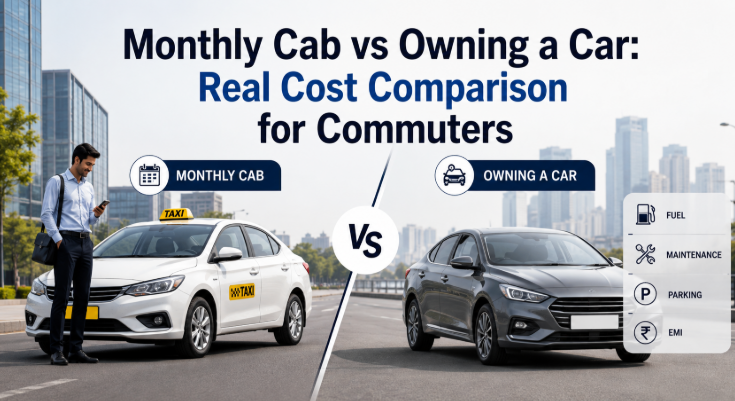
Monthly Cab vs Owning a Car: Real Cost Comparison for Commuters
Summary
For a daily office commuter in Delhi NCR, a monthly cab is usually far cheaper than owning a car, because car ownership stacks five recurring costs – EMI, fuel, maintenance, insurance and parking – that together commonly cross ₹25,000 a month, while a shared monthly cab seat on the same route typically costs a fraction of that. The comparison isn’t just money: a car also locks 500+ hours a year of your attention behind the wheel, while a cab returns that time to you. Owning still wins in specific cases – family use, weekend travel, poor cab coverage on your route – so the honest answer depends on what the car is actually for. This guide breaks down the real monthly cost of car ownership line by line, sets it against a monthly cab, shows the worked maths, and gives a simple framework to decide. All figures are illustrative for a typical NCR commute; cabrentalhub.in is one place to check live monthly cab rates for your own route while you run the numbers.
Key Takeaways
- Car ownership is five bills, not one: EMI, fuel, maintenance, insurance and parking together commonly reach ₹25,000–28,000 a month for a mid-range hatchback or compact sedan used for a daily NCR commute.
- A monthly cab replaces all five with one predictable payment, and on a shared route the per-seat cost is typically a third or less of the ownership figure.
- EMI ending doesn’t make the car free – fuel, maintenance, insurance, parking and depreciation continue, and maintenance rises as the car ages.
- Depreciation is the invisible cost: a new car loses a large share of its value in the first five years, money that never appears in a monthly bill but is real when you sell.
- The car still wins when it serves more than the commute – family duties, weekend trips, emergencies, or a route where reliable cab service doesn’t reach.
- Time is part of the price: driving yourself locks your commute hours, while a cab makes them usable for work, rest or calls.
What does owning a car really cost per month?
Owning a car for a daily commute costs the sum of five recurring heads – loan EMI, fuel, maintenance, insurance and parking – and for a typical mid-range car on a 25 km NCR office route, that total commonly lands between ₹25,000 and ₹28,000 a month. Most owners mentally count only the EMI and fuel, which is why the true figure surprises them.
Here is the line-by-line breakdown for an illustrative case: a compact car of around ₹9 lakh on-road, ₹7.5 lakh financed over five years, driven 25 km each way, 25 working days a month.
| Cost head | Illustrative monthly figure | Notes |
|---|---|---|
| Car loan EMI | ₹15,000–16,000 | ₹7.5 lakh over 5 years at prevailing rates |
| Fuel | ₹7,500–8,500 | ~1,250 km/month at city mileage and current petrol prices |
| Maintenance & servicing | ₹800–1,200 | Averaged over the year; rises as the car ages |
| Insurance | ₹1,000–1,300 | Annual premium averaged monthly |
| Parking | ₹1,000–2,000 | Office and/or society parking in NCR |
| Total | ≈ ₹25,000–28,000 | Before depreciation, tolls, cleaning, and the occasional repair |
Two costs sit outside this table and still matter. Depreciation – the value the car silently loses every year – doesn’t show up as a bill but is real money gone when you sell. And your own driving time: roughly two hours a day of attention locked to the wheel, which is a cost even though no one invoices it.
Want to see what your commute really costs?
Send us your route – we’ll share a monthly cab quote you can set against your own EMI + fuel + parking total.
What does a monthly cab cost for the same commute?
A monthly cab for the same 25 km office route costs a single fixed payment, and on a shared basis the per-seat figure is typically in the range of ₹6,000–9,000 a month in NCR, with a private (single-passenger) monthly cab costing more depending on the route, timings and vehicle. The exact figure varies by corridor and provider, so treat these as indicative and get a live quote for your route.
The important structural point is what the one payment includes: the vehicle, the driver, the fuel, the maintenance, the insurance and the parking are all the operator’s problem, not yours. There is no EMI, no servicing schedule, no premium renewal, no parking hunt. The mechanics of how these plans work – routes, timings, what’s included – are covered in this monthly cab rental guide.
Monthly cab vs owning a car: the side-by-side maths
Setting the two against each other for the same illustrative commute makes the gap concrete.
| Factor | Owning a car | Shared monthly cab |
|---|---|---|
| Monthly outflow | ≈ ₹25,000–28,000 | ≈ ₹6,000–9,000 per seat |
| Upfront cost | Down payment ₹1–2 lakh+ | Nil |
| Fuel price risk | Yours | Operator’s |
| Maintenance & breakdowns | Your time and money | Operator’s, with replacement vehicle |
| Insurance & paperwork | Yours to renew and claim | Not your problem |
| Parking | Find it and pay for it daily | None needed |
| Commute time | Locked – you’re driving | Usable – work, calls, rest |
| Asset at the end | A depreciating car you can sell | No asset, no liability |
| Flexibility beyond commute | Full – family, weekends, emergencies | Commute only |
On pure commuting economics, the shared cab wins by a wide margin – often ₹15,000–20,000 a month, or around ₹2 lakh a year, before counting depreciation or the value of the recovered time. What the car buys with that premium is availability beyond the commute, which is exactly where the decision should focus.
Doesn't the EMI end after five years?
Yes, the EMI ends, but the car doesn’t become free – fuel, insurance, parking and maintenance continue, and maintenance typically rises as the car ages past the warranty period. In the illustrative case, the post-EMI running cost still sits around ₹10,000–12,000 a month, which remains above a shared cab seat. Meanwhile the car has depreciated substantially from its purchase price, and many owners replace it within a few years of the loan ending, restarting the cycle.
The fair way to read this: ownership economics improve after the EMI, but they rarely undercut a shared cab for a commute-only car. The EMI-free years narrow the gap; they don’t reverse it.
What are the hidden costs of owning a car for commuting?
The hidden costs of commuting by owned car are depreciation, downtime, and mental load – none of which appears in the monthly budget, all of which are real.
- Depreciation. A new car loses a large share of its value in its first five years. That loss is invisible month to month and unavoidable at resale – effectively a second EMI you pay without noticing.
- Downtime. Servicing days, breakdowns, insurance claims and RTO work all cost either leave or coordination. A cab operator absorbs all of this, including sending a replacement vehicle when one breaks down.
- Mental load. Fuel price tracking, service reminders, premium renewals, challans, parking anxiety, and the daily drive itself. Two hours a day at the wheel is time you cannot work, rest or even safely take a call in – over a year, that’s several hundred hours locked away.
- Peak-hour stress. Driving NCR traffic twice daily is a fatigue cost that shows up as drained evenings, not as a line item.
A monthly cab converts all four into someone else’s job, which is the part of the comparison a pure rupee table understates.
Done with EMIs, servicing and parking hunts?
One fixed monthly payment covers the cab, driver, fuel and everything else – ask for your route’s rate.
When does owning a car still make sense?
Owning a car still makes sense when the car serves genuine needs beyond the office commute – and for many households it does. The clear cases:
- Family use. School runs, elderly parents, medical trips and weekend outings make the car a household utility, not a commute vehicle. Spread across those uses, ownership cost per trip falls sharply.
- Weekend and outstation travel. If you drive out of the city regularly, the flexibility has real value a fixed-route cab can’t replace.
- No reliable cab coverage. If your home or office sits off the serviced corridors, a monthly cab may not be available at a workable time or price.
- Unpredictable hours. If your schedule swings daily, a fixed pickup time fits poorly – though a metro cab combo commute often solves this better than a car does.
The best-of-both answer many NCR households land on: keep one family car for household use, and take a monthly cab for the office commute – the car stops doing the expensive, stressful job it’s worst at, and the household still has wheels when it matters.
How should a commuter decide? A simple framework
Decide with three questions, in order.
- Is the car mainly for the commute? If 80% of its running is home-to-office, you are paying full ownership cost for a job a cab does cheaper. If the car is a genuine family utility, keep it – and still consider the cab for the commute leg.
- Is your route served? Check whether a monthly cab runs your corridor at your timings. Dense routes are well covered – a Monthly cab service from noida to faridabad, for example, or a monthly cab service in noida – while thin routes may not be.
- Have you compared real quotes, not assumptions? Get a live monthly cab quote for your exact route and set it against your own five-line ownership total. The decision usually makes itself once both numbers are on paper. Vet the provider properly – this checklist on how to choose monthly cab vendor covers the seven questions to ask.
For commuters who don’t travel daily, the arithmetic shifts again – booking day by day can beat a monthly plan at low frequency, a trade-off worked through in monthly cab vs daily cab.
Not sure if your route is covered?
Send your pickup and drop points – we’ll confirm coverage, timings and the monthly rate in one reply.
Does this maths change for corporate employees?
Yes – if your employer runs or subsidises transport, the personal maths changes completely, because part or all of the cab cost shifts to the company. Many NCR firms now provide corporate cab services in gurgaon and similar programmes precisely because a pooled cab costs the company less than employees driving and claiming fuel. If your company offers it, taking the seat is almost always the cheapest commute available to you; if it doesn’t, the personal comparison above applies – and it’s worth forwarding this maths to your HR team.
Conclusion
For a commute-first vehicle, the numbers are one-sided: owning a car costs ₹25,000+ a month across five bills plus silent depreciation, while a shared monthly cab covers the same route for a fraction of that with zero upfront cost, zero maintenance burden, and your commute hours handed back. The car earns its keep only when it genuinely serves the household beyond the office run – family, weekends, emergencies – or when your route lacks cab coverage. Run your own five-line ownership total, get a live quote for your corridor, and compare real numbers rather than instincts; figures here are illustrative and prices change. Commuters ready to check the cab side of the equation, including cab monthly pickup and drop to office plans, can see current options on cabrentalhub.in.
Ready to retire your commute car?
Share your route and timings – get a fixed monthly cab rate and see the saving for yourself.
Frequently Asked Questions (FAQs)
Is a monthly cab cheaper than owning a car?
Yes, for a commute-focused comparison a monthly cab is usually much cheaper, because car ownership stacks EMI, fuel, maintenance, insurance and parking – commonly ₹25,000–28,000 a month for a mid-range car on a daily NCR route – while a shared monthly cab seat typically costs ₹6,000–9,000. The car justifies its premium only when it serves real needs beyond the commute. Exact figures vary by route and provider, so compare live quotes.
What is the real monthly cost of owning a car in India?
The real monthly cost of owning a commuter car is the sum of five heads: loan EMI (₹15,000–16,000 on a ₹7.5 lakh, five-year loan), fuel (₹7,500–8,500 for ~1,250 km of city driving), maintenance (₹800–1,200 averaged), insurance (₹1,000–1,300) and parking (₹1,000–2,000). That totals roughly ₹25,000–28,000 before depreciation, tolls and occasional repairs. Most owners underestimate it because only the EMI and fuel feel like bills.
What does a monthly cab include that a car EMI doesn't?
A monthly cab fee includes the vehicle, driver, fuel, maintenance, insurance and parking in one payment, while a car EMI covers only the loan on the vehicle itself – every other cost is separate and yours. The cab also includes operational cover, such as a replacement vehicle if one breaks down. The EMI does build ownership of an asset, but that asset depreciates continuously.
Is a car free to run once the EMI is over?
No – after the EMI ends you still pay fuel, insurance, parking and maintenance, typically ₹10,000–12,000 a month for a daily NCR commute, and maintenance rises as the car ages out of warranty. The post-EMI years narrow the gap with a monthly cab but rarely close it for commute-only use. Depreciation also continues until the day you sell.
When is owning a car better than taking a monthly cab?
Owning wins when the car is a genuine household utility – school runs, family trips, medical needs, weekends and outstation travel – or when your home or office sits outside serviced cab corridors, or your hours are too unpredictable for a fixed pickup. In those cases the ownership cost is spread across many uses, not just the commute. Many households keep one family car and still use a monthly cab for the office run.
How much can a commuter save by switching to a monthly cab?
On the illustrative NCR numbers, switching a commute-only car for a shared monthly cab saves roughly ₹15,000–20,000 a month, or around ₹2 lakh a year, before counting depreciation avoided and commute hours recovered. Actual savings depend on your car, route, and the cab plan you choose. Comparing your own ownership total against a live route quote gives the true figure.
Does a monthly cab make sense if I only go to office 3 days a week?
At three days a week the maths tightens, because a monthly plan prices in regular use – a hybrid approach or day-wise booking may cost less at low frequency. Some providers offer flexible or alternate-day monthly plans, which are worth asking about for hybrid schedules. Comparing a monthly plan against daily booking for your actual attendance pattern settles it quickly.

What Are the Best Group Trip Ideas for Office Teams Near Delhi NCR?
What Are the Best Group Trip Ideas for Office Teams Near Delhi NCR? Summary The best group trip ideas for...
October 5, 2026

How Do You Plan a Char Dham Yatra from Faridabad?
How Do You Plan a Char Dham Yatra from Faridabad? Summary Planning a Char Dham Yatra from Faridabad means organising...
October 5, 2026

What Questions Should You Ask a Travel Agent Before Paying an Advance?
What Questions Should You Ask a Travel Agent Before Paying an Advance? Summary Before you pay any advance to a...
October 5, 2026