
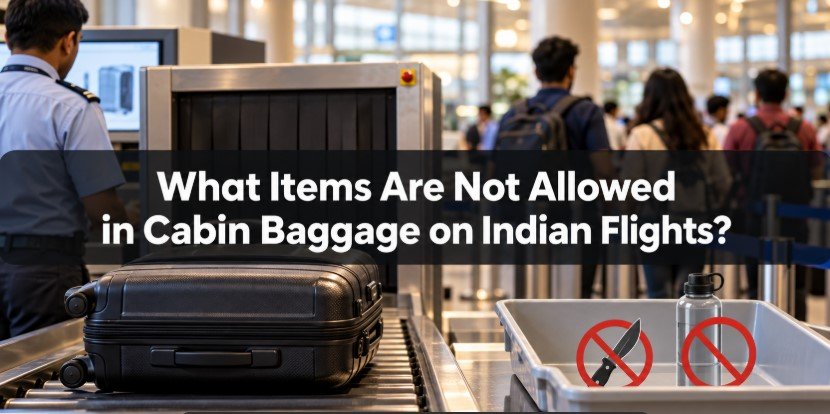
What Items Are Not Allowed in Cabin Baggage on Indian Flights?
Summary
On Indian flights, cabin baggage rules fall into three groups. Not allowed in the cabin but fine in checked baggage: liquids and gels over 100 ml per container, sharp objects (knives, scissors above the permitted size, blades) and tools or sporting goods. Allowed in the cabin only, never in checked baggage: power banks and spare/loose lithium batteries, and e-cigarettes. Banned from the aircraft entirely: explosives, fireworks, flammable liquids and gases, corrosives, compressed-gas cylinders and firearms (unless licensed and declared in advance). Power banks up to 100 Wh are generally fine; 100–160 Wh needs airline approval; over 160 Wh is banned. This guide explains the items not allowed in cabin baggage in India – liquids, power banks, sharp items and BCAS-banned goods – so you pack right and avoid delays at security. Security rules are set by the BCAS and airlines and change from time to time, so always check the current list and your airline before you fly.
Key Takeaways
- Liquids: only containers of 100 ml or less in the cabin; bigger go in checked bags.
- Power banks & spare lithium batteries: cabin only, never in checked baggage.
- Power bank capacity: up to 100 Wh free; 100–160 Wh with airline approval; over 160 Wh banned.
- Sharp objects & tools: not in the cabin – pack in checked baggage.
- Banned entirely: explosives, flammables, corrosives, compressed gas, weapons (unless licensed/declared).
- Always check the current BCAS and airline rules before you travel.
The three categories to understand
Airport security in India is overseen by the Bureau of Civil Aviation Security (BCAS), and the rules sort items into three buckets. Getting these right saves you time at the security check and avoids items being confiscated:
- Not in cabin, but OK in checked baggage – e.g. large liquids, sharp objects, tools.
- Cabin only, never in checked baggage – e.g. power banks, spare lithium batteries, e-cigarettes.
- Banned from the aircraft entirely – e.g. explosives, flammables, weapons.
Most confusion at security comes from mixing up the first two – putting a power bank in a checked bag (not allowed) or a full-size shampoo in the cabin (not allowed). Keep the categories straight and packing becomes simple.
Liquids in cabin bags (the 100 ml rule)
Liquids, gels and aerosols in the cabin must be in containers of 100 ml or less – this covers water, drinks, shampoo, lotions, perfumes, toothpaste and similar. The size of the container is what matters, not how full it is, so a half-empty 200 ml bottle is still not allowed. Larger quantities should go in your checked baggage instead.
- Keep toiletries small – travel-size containers of 100 ml or under for the cabin.
- Bigger bottles go checked – full-size shampoo, perfume, etc.
- Medicines and baby food are usually allowed in reasonable quantities – declare them at security.
- Duty-free liquids bought after security are generally fine – keep the sealed bag and receipt.
Power bank and lithium battery rules
This is the rule travellers most often get wrong. Power banks and spare or loose lithium batteries must be carried in your cabin baggage only – never in checked baggage, because of fire-safety risk in the hold. The same applies to spare laptop, camera and phone batteries. Power banks are also subject to capacity limits:
| Power bank capacity | Status (general guide) |
|---|---|
| Up to 100 Wh (about 27,000 mAh) | Allowed in cabin, no approval needed |
| 100–160 Wh | Allowed with airline approval, usually quantity-limited |
| Over 160 Wh | Not allowed |
A note on the power bank rules for flights: some airlines have also introduced restrictions on using or charging power banks during the flight, so check your airline’s current policy. E-cigarettes and vapes are likewise cabin-only, and using them on board is banned. When in doubt, keep all batteries and power banks with you in the cabin, and check capacity markings before you pack.
Off to the airport? Book a reliable cab
Pack right, then travel easy – a Faridabad airport taxi with a pickup timed to your flight and a drop at your terminal.
Sharp objects and tools
Anything that could be used as a sharp implement is not allowed in the cabin, though most can travel in checked baggage. This includes knives, scissors above the permitted size, blades and box cutters, as well as tools like spanners, screwdrivers and drills, and sporting goods such as cricket bats and hockey sticks.
- Pack sharp items and tools in checked baggage – not the cabin.
- Disposable razors are generally allowed in the cabin; loose blades are not.
- Small scissors may be allowed up to a permitted blade length – check the current limit.
- Sporting equipment goes in checked baggage as per your airline’s allowance.
BCAS banned items: not allowed at all
Some items are prohibited from the aircraft entirely – neither cabin nor checked baggage – because they are dangerous. The BCAS-banned items broadly include:
- Explosives and fireworks of any kind.
- Flammable liquids and gases – petrol, lighter fuel, certain aerosols.
- Corrosives and toxic substances – acids, strong chemicals.
- Compressed-gas cylinders (non-medical).
- Firearms and ammunition – not permitted unless licensed and declared in advance per the rules.
These are hard prohibitions for everyone’s safety. If you have a genuine need to transport a restricted item (for example a licensed firearm or a specific medical item), follow the official declaration and approval process well in advance – do not simply pack it. Always refer to the current BCAS and airline lists, as specifics change.
Travel day made simple
Doorstep pickup, luggage space and an on-time drop at your terminal – book a Faridabad airport cab and start your trip relaxed.
Quick reference: where does it go?
A simple summary to pack by (always confirm current rules and your airline’s policy):
| Item | Cabin | Checked | Notes |
|---|---|---|---|
| Liquids/gels over 100 ml | No | Yes | Cabin only in ≤100 ml containers |
| Power bank / spare batteries | Yes | No | Cabin only; capacity limits apply |
| Knives, blades, tools | No | Yes | Sharp items in checked bags |
| Disposable razor | Yes | Yes | Loose blades not allowed in cabin |
| E-cigarette / vape | Yes | No | Cabin only; use on board banned |
| Explosives, flammables, firearms* | No | No | Banned (*firearms only if licensed/declared) |
Tips to pack smart and clear security fast
- Sort by category before packing – cabin, checked, or leave behind.
- Keep liquids in a small pouch of ≤100 ml containers, easy to take out at security.
- Put power banks and batteries in your cabin bag, within reach for checks.
- Move sharp items and tools to checked baggage in advance.
- Check your airline’s specifics – allowances and limits vary.
- Arrive early so a recheck or repack does not cost you your flight.
A little pre-planning means a quick, smooth security check and no last-minute surprises – which starts with a calm, on-time arrival at the airport.
Start your trip stress-free
Bags packed to the rules, ride sorted – book a Faridabad airport cab with an on-time pickup and a drop at your terminal.
Getting to the airport from Faridabad
Once your bags are packed to the rules, the next step is a smooth trip to the airport. Delhi’s IGI is roughly 35 to 45 km from Faridabad, about a 1 to 1.5 hour drive, so leave a comfortable buffer and confirm your terminal in advance. A pre-booked cab makes this the easy part of the day.
A dedicated airport taxi from Faridabad offers a fixed doorstep pickup, luggage space and a drop at the correct terminal, so you arrive relaxed and on time. For a return pickup or other travel, cab service in Faridabad can arrange it around your flight schedule.
Airport pickup and drop by sector
Faridabad spreads across many sectors and colonies, and a good local service offers doorstep pickup from all of them, timed to your flight. Wherever you live, book ahead so a car is ready when you need to leave, with your route and terminal planned in advance.
For example, residents of the southern side can arrange a cab in Greenfield Faridabad for an airport drop or pickup, planned around your reporting time. Booking early removes the morning-of-flight uncertainty – the car is waiting, and you travel with time to spare.
Conclusion
On Indian flights, the cabin baggage rules are easy once you know the three categories: large liquids, sharp objects and tools go in checked baggage; power banks and spare lithium batteries go in the cabin only (up to 100 Wh freely, 100–160 Wh with approval, over 160 Wh banned); and explosives, flammables, corrosives, compressed gas and weapons are banned from the aircraft entirely. Keep cabin liquids to 100 ml containers, pack batteries in your cabin bag, and move anything sharp to checked baggage. Rules are set by the BCAS and airlines and change, so always check the current list and your airline before you fly – then let a comfortable cab handle the trip to the airport.
Frequently Asked Questions (FAQs)
What items are not allowed in cabin baggage on Indian flights?
Not allowed in the cabin (but fine in checked baggage) are liquids and gels over 100 ml per container, sharp objects like knives, large scissors and blades, and tools or sporting goods. Banned from the aircraft entirely are explosives, fireworks, flammable liquids and gases, corrosives, compressed-gas cylinders and firearms (unless licensed and declared). Power banks and spare lithium batteries, by contrast, must go in the cabin only. Always check the current BCAS and airline rules before flying.
Can you carry a power bank in cabin baggage in India?
Yes – in fact power banks and spare or loose lithium batteries must be carried in your cabin baggage only, never in checked baggage, due to fire-safety risk in the hold. Capacity limits apply: up to about 100 Wh (roughly 27,000 mAh) is generally allowed without approval, 100 to 160 Wh needs airline approval and is usually quantity-limited, and over 160 Wh is not allowed. Some airlines also restrict using or charging power banks in flight, so check your airline.
What is the liquid limit in cabin baggage?
Liquids, gels and aerosols in the cabin must be in containers of 100 ml or less – this covers water, drinks, shampoo, lotions, perfumes and toothpaste. It is the container size that matters, not how full it is, so a part-used 200 ml bottle is still not allowed. Larger quantities go in checked baggage. Medicines and baby food are usually permitted in reasonable amounts if declared, and sealed duty-free liquids bought after security are generally fine.
Can you carry scissors or a razor in cabin baggage?
Disposable razors are generally allowed in the cabin, but loose blades are not. Scissors may be allowed only up to a permitted blade length – check the current limit – while larger scissors, knives, blades and box cutters are not allowed in the cabin and must go in checked baggage. When unsure, pack sharp items in your checked bag to avoid them being confiscated at the security check. Rules can change, so confirm before you travel.
What are BCAS banned items on flights?
BCAS-banned items are those prohibited from the aircraft entirely – neither cabin nor checked baggage – because they are dangerous. They broadly include explosives and fireworks, flammable liquids and gases, corrosives and toxic substances, non-medical compressed-gas cylinders, and firearms and ammunition (not permitted unless licensed and declared in advance per the rules). If you must transport a restricted item legitimately, follow the official declaration and approval process well ahead of travel.
Can lithium batteries go in checked baggage?
Spare or loose lithium batteries and power banks must go in the cabin only, not in checked baggage, because of fire-safety risk in the hold. Devices with built-in batteries (like a laptop or phone) can generally be carried, but spare batteries and power banks always belong in your cabin bag, within reach. Observe the capacity limits for power banks, and check your airline’s specific policy, as some have additional restrictions on in-flight use.
How do you clear airport security quickly in India?
Sort your items by category before packing – cabin, checked, or leave behind. Keep cabin liquids in a small pouch of 100 ml containers that is easy to take out, put power banks and batteries in your cabin bag within reach, and move sharp items and tools to checked baggage in advance. Check your airline’s specific allowances, and arrive early so a repack or recheck does not cost you your flight. A calm, on-time arrival by cab helps this go smoothly.

How Far Is Chandigarh from Faridabad by Road?
How Far Is Chandigarh from Faridabad by Road? Summary Chandigarh is roughly 260 to 285 km from Faridabad by road,...
October 12, 2026
What Items Are Not Allowed in Cabin Baggage on Indian Flights?
What Items Are Not Allowed in Cabin Baggage on Indian Flights? Summary On Indian flights, cabin baggage rules fall into...
October 12, 2026

Metro or Road: What Is the Fastest Way from Faridabad to Delhi Airport?
Metro or Road: What Is the Fastest Way from Faridabad to Delhi Airport? Summary For most travellers heading to a...
October 12, 2026