
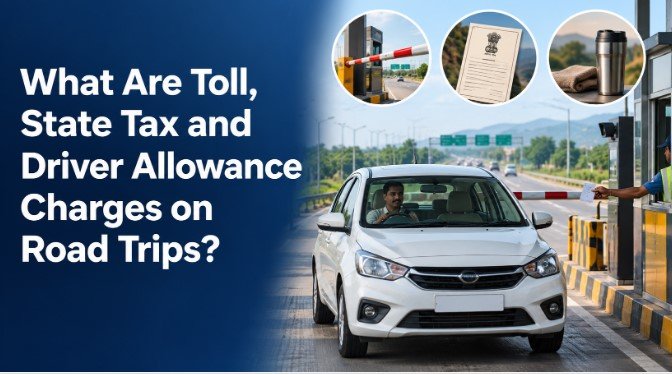
What Are Toll, State Tax and Driver Allowance Charges on Road Trips?
Summary
On an outstation road trip, the fare is rarely just the per-kilometre rate – it usually carries three extra charges: tolls (fees for using certain highways and expressways), state entry tax (a charge for a commercial vehicle crossing into another state), and driver allowance (a per-night amount covering the driver’s food and stay on multi-day trips), sometimes with a night charge for late-hour driving. These are standard, legitimate charges, not hidden extras – the only thing that makes them feel like surprises is not knowing about them in advance. Tolls and state tax depend on your route and how many plazas and borders you cross; driver allowance depends on how many nights you are away; and night charges depend on the operator. A reputable operator either includes them in an all-inclusive quote or itemises them clearly, so the smart move is simply to ask which before you book. This guide explains each charge, why it applies, roughly how it is calculated, and how to get a transparent, all-inclusive outstation fare.
Key Takeaways
- Toll charges are fees for using tolled highways and expressways, paid per plaza on your route.
- State entry tax is a legitimate charge for a commercial cab crossing into another state.
- Driver allowance is a per-night amount for the driver’s food and stay on multi-day trips.
- Night charges may apply for driving in late-night hours, depending on the operator.
- These are standard, not hidden – the fix is to ask whether they are included or added.
- Prefer an all-inclusive quote so tolls, tax and allowance are accounted for up front.
Why does an outstation fare have extra charges?
An outstation trip is longer, crosses state lines, and often keeps the driver away from home for a night or more, so the fare reflects costs that a short city ride simply does not have. Tolls fund the highways you travel on, state tax is levied when a commercial vehicle enters another state, and the driver allowance covers the real cost of the driver being on the road with you overnight. None of these is the operator padding the bill – they are pass-through and cost-recovery charges that any honest fare has to account for.
The problem is never the charges themselves; it is when they are not disclosed before booking, so the final bill is higher than the headline rate suggested. That is exactly why the single most useful habit is to confirm, in writing, whether these are included in your quote or added at the end. Understanding what each one is makes that conversation easy.
The three main charges at a glance
Here are the three core charges, plus night charges, in one view – what each is, why it applies, and what it depends on. Each is explained in detail below.
| Charge | What it is | Depends on |
|---|---|---|
| Toll | Fee for using tolled highways / expressways | Number of plazas on the route |
| State entry tax | Charge for a commercial cab entering another state | Which and how many states you cross |
| Driver allowance | Per-night amount for driver’s food and stay | Number of nights away |
| Night charge | Fee for driving in late-night hours | Operator policy and timing |
Toll charges explained
Toll charges are fees you pay for using certain national highways and expressways, collected electronically via FASTag at toll plazas along the route. They are a pass-through cost – the operator pays them on your trip and they form part of your fare, whether bundled in or added at actuals. The total depends entirely on your route: a journey that passes several plazas costs more in tolls than one that passes few or none.
Because tolls vary by route and are revised periodically, they are usually best treated as an actual cost rather than a fixed number. When comparing quotes, check whether tolls are already included; a lower headline rate that adds tolls separately can end up higher than an all-inclusive one. On a route like a Faridabad to Haridwar cab, the tolls along the highway are a normal part of the trip cost, so it is worth confirming they are covered in your quote.
State entry tax explained
State entry tax – sometimes called a border or commercial vehicle tax – is a legitimate charge levied when a commercial cab enters another state. Because a taxi registered in one state is operating in another, that state charges a fee for the privilege, which is separate from tolls and from the driver allowance. It applies on interstate trips and depends on which states, and how many, your route crosses.
For you as the traveller, the practical point is simply to know whether this tax is included in your fare or payable on the route, so it does not come as a surprise at a state border. A professional operator accounts for it clearly as part of an interstate quote; vagueness about state tax is a sign to ask more questions before booking.
Want an all-inclusive outstation fare with no surprises?
Tell us your route and dates – we’ll quote a fare with tolls, state tax and driver allowance accounted for up front, in writing.
Driver allowance explained
Driver allowance, sometimes called driver bata or night halt charge, is a per-night amount that covers the driver’s food and accommodation when a trip keeps them away from home overnight. It is not a tip or an optional extra – it is a standard part of any multi-day outstation fare, because the driver has real living costs on the road while looking after your trip.
The allowance is charged per night away, so a two-night trip carries roughly twice the allowance of a one-night trip. It typically does not apply to a same-day return trip, where the driver returns home the same night. When booking a multi-day journey, ask for the per-night allowance as an actual number so you can factor it into the total, and confirm whether it is already included in your quote.
Night charges explained
Some operators apply a night charge for driving during late-night hours – broadly the small hours of the morning – to account for the added demand of driving through the night. Unlike the driver allowance, which is about being away overnight, a night charge is specifically about driving in those late hours.
Not every operator levies it, and it depends on your travel timing, so it is worth asking whether a night charge applies to your trip if you plan to travel or depart very late or very early. As with the other charges, the key is disclosure: know before you book, not at drop-off.
How the charges add up: an illustration
To see how these combine, here is an illustrative breakdown of a multi-day outstation trip using placeholder descriptions rather than fixed amounts – your actual figures depend on the route, states and nights, so treat this as the structure, not a quote.
| Component | What it covers | How it scales |
|---|---|---|
| Base fare | Kilometres at the per-km rate or package | With total distance / daily minimum |
| Tolls | Highway and expressway plazas | With plazas on the route |
| State entry tax | Crossing into other states | With states crossed |
| Driver allowance | Driver’s food and stay | Per night away |
| Night charge (if any) | Late-night driving | Operator policy and timing |
| Total payable | All of the above | Sum for your specific trip |
The pattern is clear: start with the base fare, then add tolls and state tax by route, the driver allowance by nights, and any night charge. Once you know each element, the total is predictable – which is why an itemised or all-inclusive quote matters so much.
Confused by outstation charges? We’ll make it clear.
Share your route and dates – we’ll break down exactly what applies and share one clear, all-inclusive figure.
How to avoid surprises on your fare
These simple checks keep your outstation bill predictable.
- Ask if the quote is all-inclusive. Does it cover tolls, state tax and driver allowance, or are they added?
- Get the driver allowance as a number. Per night, so you can multiply by the nights away.
- Check for night charges. Especially if you travel or depart in late-night hours.
- Confirm the daily minimum kilometres. It shapes the base fare on multi-day trips.
- Get it in writing. A WhatsApp fare breakup prevents nearly every dispute at drop-off.
Comparing quotes on the per-kilometre rate alone is the classic mistake, because a low rate that excludes tolls, tax and allowance can finish higher than an all-inclusive one. A transparent taxi service in Faridabad will lay these out clearly, so you know the real, final cost before you commit.
Planning a road trip? Get a clear, all-in quote today.
One message, one final figure – tolls, state tax and driver allowance sorted before you travel.
Conclusion
Toll, state tax and driver allowance are the three standard charges that turn an outstation per-kilometre rate into a real total – tolls for the highways you use, state tax for crossing into other states, and a per-night allowance for the driver being away with you, sometimes with a night charge for late-hour driving. None of these is hidden or unfair; they only cause friction when they are not disclosed up front. So the whole trick is disclosure: ask whether your quote is all-inclusive, get the allowance and daily minimum as numbers, and confirm it in writing. Do that, and your outstation fare holds no surprises from the first toll plaza to the final drop.
Frequently Asked Questions (FAQs)
What extra charges apply on an outstation road trip?
An outstation fare usually carries three main extra charges beyond the per-kilometre rate: tolls (fees for tolled highways and expressways), state entry tax (a charge for a commercial cab crossing into another state), and driver allowance (a per-night amount for the driver’s food and stay on multi-day trips). Some operators also add a night charge for driving in late-night hours. These are standard, legitimate charges, not hidden extras.
What is driver allowance or driver bata?
Driver allowance, also called driver bata or night halt charge, is a per-night amount that covers the driver’s food and accommodation when a trip keeps them away from home overnight. It is a standard part of any multi-day outstation fare, charged per night away, so a two-night trip carries roughly twice the allowance of a one-night trip. It usually does not apply to a same-day return trip where the driver comes home the same night.
What is state entry tax on a cab trip?
State entry tax, sometimes called a border or commercial vehicle tax, is a legitimate charge levied when a commercial cab enters another state, because a taxi registered in one state is operating in another. It is separate from tolls and driver allowance, applies on interstate trips, and depends on which and how many states your route crosses. Confirm whether it is included in your fare or payable on the route.
Are toll charges included in the cab fare?
Tolls may be included in an all-inclusive quote or added at actuals, so it varies by operator – always ask which. Tolls are a pass-through cost for using tolled highways and expressways, collected via FASTag at plazas, and the total depends on how many plazas your route crosses. A lower headline rate that adds tolls separately can end up higher than an all-inclusive fare, so compare on the total.
Do night charges apply to outstation trips?
Some operators apply a night charge for driving during late-night hours, to account for the added demand of driving through the night. It is different from the driver allowance, which covers being away overnight. Not every operator levies it and it depends on your travel timing, so if you plan to depart or travel very late or very early, ask whether a night charge applies to your trip.
How can I avoid surprise charges on an outstation fare?
Ask whether the quote is all-inclusive of tolls, state tax and driver allowance, get the driver allowance as a per-night number, check whether any night charge applies, and confirm the daily minimum kilometres that shape the base fare. Most importantly, get the fare breakup in writing, ideally on WhatsApp. Comparing only the per-km rate is the classic mistake, since a low rate that excludes these can finish higher.
Why is an outstation fare more than just the per-km rate?
Because an outstation trip is longer, crosses state lines and often keeps the driver away overnight, the fare has to cover costs a city ride does not: tolls for the highways, state tax for entering other states, and a driver allowance for the driver’s food and stay. These are pass-through and cost-recovery charges rather than padding, which is why an honest fare accounts for them and a transparent operator discloses them up front.

What Is the Golden Triangle Tour and How Many Days Does It Need?
What Is the Golden Triangle Tour and How Many Days Does It Need? Summary The Golden Triangle is India’s most...
October 17, 2026
What Should Drivers Know About the Delhi–Mumbai Expressway to Jaipur?
What Should Drivers Know About the Delhi–Mumbai Expressway to Jaipur? Summary The Delhi–Mumbai Expressway has made the drive to Jaipur...
October 17, 2026

What Is the Perfect 2-Day Jaipur Itinerary?
What Is the Perfect 2-Day Jaipur Itinerary? Summary Two days is ideal for Jaipur – enough to cover the Pink...
October 17, 2026