

How Corporate Cab Contracts Work: SLA, Billing & Vendor Selection Explained
Summary
Key Takeaways
- A corporate cab contract is a service contract, not a booking. It defines fleet commitment, SLA benchmarks, penalty rules, billing basis and exit terms for a fixed term, usually 12 to 36 months.
- The billing basis matters more than the headline rate. A ₹14/km quote billed garage-to-garage can cost more than a ₹17/km quote billed office-to-office, because dead kilometres are silently added.
- A usable SLA cab vendor clause has three parts: a measurable metric, a numeric benchmark, and a stated financial consequence. Metrics without penalties are not enforceable in practice.
- On-time pickup percentage is the single most-tracked SLA metric, with 95–98% being the standard corporate benchmark measured on a monthly rolling basis.
- Corporate cab billing in India attracts GST at either 5% without input tax credit or 12% with full ITC, and TDS under Section 194C applies to the contract value.
- The vendor selection process should weight compliance and capacity above price – commercial permits, AIS-140 GPS, driver police verification and insurance validity are pass/fail gates, not scoring criteria.
What is a corporate cab contract?
Companies use these contracts for home-to-office pick and drop, night-shift transport, airport transfers for visiting staff, and dedicated vehicles attached to senior management. Larger organisations often run all four under a single master services agreement with separate rate annexures. For the broader operating picture beyond the contract itself, see this guide to employee transportation solutions.
What are the main types of corporate cab contracts?
| Contract type | How it is billed | Company pays for | Best suited to |
|---|---|---|---|
| Fixed monthly rental (dedicated) | Flat monthly fee per vehicle, with a bundled km and hour cap (e.g. 2,500 km / 300 hrs) | Idle time as well as running time | Fixed rosters, management cars, single-route commutes |
| Per-kilometre / per-trip | Rate per km or a fixed rate per defined trip | Only distance actually travelled | Variable headcount, ad-hoc travel, spread-out teams |
| Slab-based | Tiered rate that drops as monthly volume rises | A blended rate tied to usage bands | Companies scaling headcount through the year |
| Per-seat shuttle | Rate per occupied seat on a fixed route and timing | Utilisation, not vehicles | 40+ employees clustered along a corridor |
Which contract type fits which company?
What should an SLA for a cab vendor include?
| SLA metric | Typical benchmark | How it is measured | Common consequence |
|---|---|---|---|
| On-time pickup | 95–98% monthly | GPS timestamp vs rostered time, 10-min grace | 0.5–2% of monthly invoice per percentage point below benchmark |
| Vehicle no-show | ≤ 0.5% of scheduled trips | Trip sheet vs roster reconciliation | Fixed per-incident penalty plus reimbursement of alternate transport |
| Replacement vehicle on breakdown | Within 30–45 minutes | Incident log with timestamps | Per-incident penalty; repeat breach triggers vehicle removal |
| GPS / tracking uptime | ≥ 98% | Tracking platform report | Withholding of tracking-linked charges |
| Driver behaviour complaints | ≤ 1 per 1,000 trips | Logged employee complaints | Driver blacklisting; escalating penalty on repeat |
| Escalation response | Acknowledge in 15 min, resolve in 4 hrs | Helpdesk ticket log | Service credit |
| Vehicle age and condition | ≤ 4–5 years, monthly audit pass | Physical audit and fitness certificate | Vehicle rejection without substitution charge |
Are SLA penalties actually enforceable?
What safety and compliance clauses belong in the SLA?
These clauses belong in the contract rather than in a policy circular, because only the contract makes them the vendor’s legal obligation. Companies that already maintain an employee transport policy template should cross-reference it in the agreement so the two documents cannot drift apart.
How does corporate cab billing work?
What is the difference between garage-to-garage and office-to-office billing?
What extra charges appear on corporate cab invoices?
How do GST and TDS apply to corporate cab contracts?
What should the reconciliation process look like?
Fixed monthly contract vs pay-per-trip: which costs less?
| Factor | Fixed monthly contract | Pay-per-trip |
|---|---|---|
| Cost predictability | High – same invoice each month | Low – varies with usage |
| Cost at high utilisation | Lower per trip | Higher per trip |
| Cost at low utilisation | Higher – you pay for idle vehicles | Lower – you pay only for use |
| Vehicle and driver consistency | Same driver and vehicle daily | Varies by trip |
| Administrative effort | Low – one line item | High – trip-level verification |
| Suits | Fixed shifts, single corridors, dedicated cars | Ad-hoc travel, variable rosters |
The break-even point in most NCR corporate setups sits around 60–65% utilisation of the committed vehicle. Below that, per-trip billing is usually cheaper. A related cost question – whether to run company transport at all or reimburse employees – is worked through in this comparison of employee cab service vs fuel reimbursement.
How does the corporate cab vendor selection process work?
- Define the requirement. Document routes, shift timings, peak headcount, vehicle categories, escort needs and expected monthly kilometres. Vendors cannot quote accurately against vague demand, and inaccurate quotes become change requests later.
- Issue an RFP with a standard rate template. Require every vendor to quote on the same billing basis, the same package caps and the same extra-charge heads. Free-format quotes are impossible to compare.
- Run a compliance gate. Verify commercial permit, fitness certificate, insurance, PUC, driver badges, police verification, AIS-140 GPS, GST registration and PF/ESI compliance for drivers. Treat these as pass/fail.
- Assess operational capacity. Check owned versus aggregated fleet ratio, average vehicle age, driver-to-vehicle ratio, backup vehicle availability, and whether the vendor already operates in your corridor.
- Evaluate commercially against a weighted scorecard. Price should carry meaningful but not dominant weight.
- Run a 30 to 60 day pilot on one route before signing the full term, and make the SLA live during the pilot so you are measuring real performance rather than promises.
What should the vendor scorecard weight?
| Evaluation criterion | Suggested weight |
|---|---|
| Commercial rate and total cost of ownership | 30% |
| Fleet capacity, ownership ratio and vehicle age | 20% |
| Safety record, GPS platform and escort capability | 20% |
| Corporate client references in a comparable corridor | 15% |
| Technology – app, MIS reports, automated billing | 10% |
| Financial stability and years in operation | 5% |
Which contract clauses do companies most often forget?
Conclusion
A corporate cab contract works when three things line up: the structure matches your actual demand pattern, the SLA converts expectations into measurable numbers with financial consequences, and the billing annexure leaves no room for interpretation about what counts as a chargeable kilometre. Choose the contract type from your roster stability, not from the vendor’s preference. Write the SLA as service credits rather than damages. Fix the billing basis before you negotiate the rate. And screen vendors on compliance and corridor experience before you look at price, because a cheap non-compliant vendor becomes an HR problem, not just a procurement one – poor commute reliability is a documented driver of commute related attrition. Companies benchmarking rates and structures before they draft an RFP can look at how daily, monthly and corporate arrangements are typically packaged on cabrentalhub.in.
Frequently Asked Questions (FAQs)
What is a corporate cab contract?
What should be included in an SLA for a cab vendor?
How is corporate cab billing calculated?
What is the typical payment cycle for corporate cab services in India?
What GST rate applies to corporate cab contracts?
How do you choose a corporate cab vendor?
Is a fixed monthly cab contract cheaper than pay-per-trip?

GST & Billing Rules for Corporate Cab Vendors in India
GST & Billing Rules for Corporate Cab Vendors in India Summary Corporate cab services in India are taxed under GST...
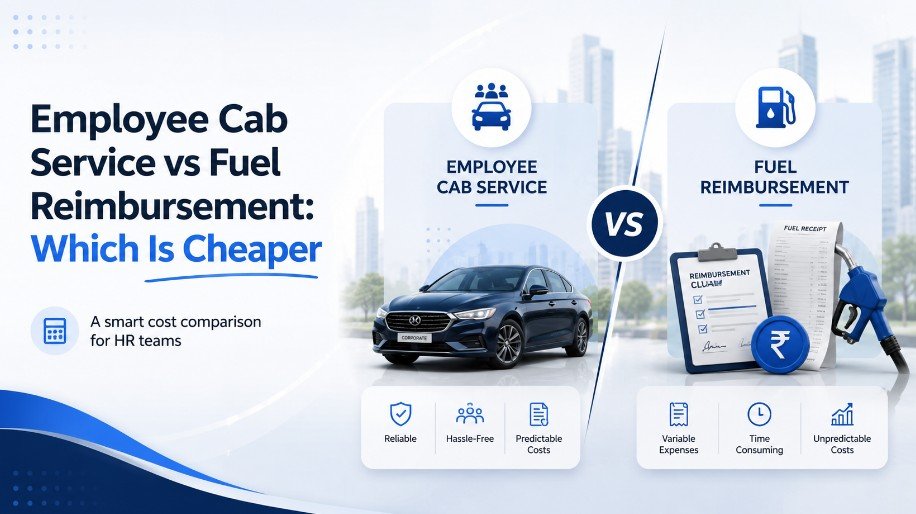
Employee Cab Service vs Fuel Reimbursement: Which Is Cheaper
Cost of Employee Cab Services vs Reimbursing Fuel Bills — Which Is Cheaper? Summary For most companies moving a group...
Best Fleet Management Companies in 2026: Top 10 Providers
Best Fleet Management Companies in 2026: Top 10 Providers and How to Choose Summary A fleet management company handles the...
